
|
Getting your Trinity Audio player ready...
|
Last updated on August 19th, 2026
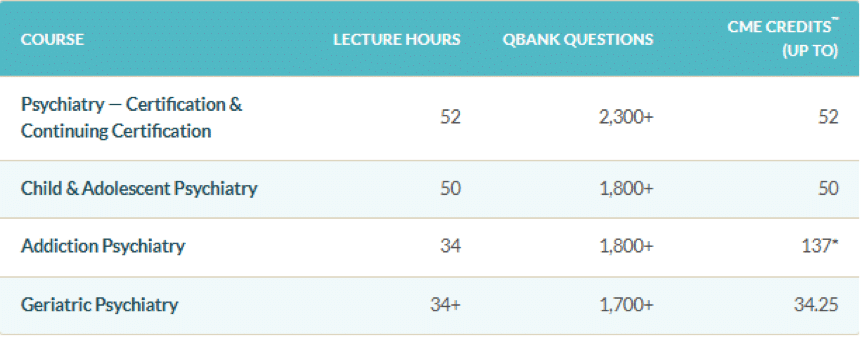
Beat the Boards! courses, as is explicit in their name, are designed for ABPN® board preparation and are judged by their effectiveness in getting exam candidates to pass their exams. By this standard, Beat The Boards! Courses are extremely successful, racking up very high pass rates among users and maintaining their #1 sales position in psychiatric board prep for over two decades.
Given their board focus, it is not self-evident that Beat The Boards! courses are also effective general psychiatry reviews or excellent curriculum aids for speeding and deepening the learning of psychiatry residents and fellows as well as of trainees in allied mental health fields.
But, in fact, the very structure and features that make Beat The Boards! courses excellent board preparation resources also make them excellent as general reviews of psychiatry and its subspecialties and as curriculum aids in psychiatry training programs.
What exactly are these features that make Beat The Boards! courses excellent curriculum aids? Let me present 5 of them below.
Comprehensive Reviews of Psychiatry
Beat The Boards! courses cover every diagnosis in the DSM-5-TR. Each disorder is presented, starting from its biological and psychological underpinnings, continuing through its diagnostic criteria and clinical presentations, moving into its comorbidities and differential, prognosis, and risk and protective factors. And, of course, the largest focus for each disorder is on assessment and management interventions. Since psychiatrists must be competent to deploy pharmacologic, neuromodulation, and psychotherapies and related psychosocial interventions, these are all presented as they relate to each disorder under discussion.
But to be ready to take a board exam AND to practice psychiatry competently, many additional aspects of practice need to be presented. They include suicide- and violence-related issues, family and community involvement, ethics, medical-legal issues, professionalism, policy, and systems of care.
Other foundational topics are also presented, including foundations of neurology and neuroscience, of epidemiology and statistics and research methods, and of behavioral sciences.
There are additional resources within each Beat The Boards! course specific to preparing for and taking a ABPN® board exam and passing!
In effect, any psychiatric resident and fellow can confidently use Beat The Boards! courses to advance their core (and not so core) Psychiatric knowledge and skill AND to position themselves to pass their board exam when that professional milestone presents itself.
The benefit of learning from a Beat The Boards! course over the training period, as opposed to last minute use as board preparation, is that the psychiatric knowledge and the test-taking practice and skill gained have consolidated over many months or years.
Systematic Structure
As presented above, Beat The Boards! are comprehensive and extensive. And although that is their foundational feature, it alone may not be enough for a successful learning resource.
What elevates Beat The Boards! course is that they present all their content, for many courses over 50 hours worth of presentations, in a systematic way. Presentation of every disorder follows a set format. The goal is that the learner falls into a groove where they know what to expect from the presentation and the structure of the lecture no longer stands in the way of focusing on the subject matter. The structure becomes invisible because of its regularity.
Beat The Boards! course are not only praised for their comprehensive coverage but for the quality of their lecture presentations. All Beat The Boards! faculty members adhere to our strict editorial guidelines. Also, it bears pointing out that all Beat The Boards! courses are approved for AMA PRA Category 1 CME credits®. Even if these credits are not needed by trainees, they convey that Beat The Boards! course follow these ACCME guidelines, assuring their quality and the absence of medical bias or unsupported interventions.
Deeper Form of Learning
Beat The Boards! courses are also distinguished by helping the learner learn as quickly, easily, and deeply as possible. A two-sided approach that does this is what I call Macro-Micro Learning. Macro means a focus on presenting the underlying concepts and biological-psychological processes that explain the thousands of individual facts that must be learned. Micro refers to the details of pharmacokinetics, pharmacodynamics, diseases, assessments, and treatment interventions. These thousands of facts are placed in context so their not simply memorized but understood and made deployable.
In addition in Beat The Boards! courses, I and the other faculty point out common areas of oversight and confusion and how disorders can best be distinguished from each other.
The most rewarding comments I receive are from learners who say they finally understood something after being confused by it since the beginning of their medical training.
Effective Learning Through Use of QBanks
Beat The Boards! course, given that they are preparation for ABPN® exams, include extensive questions banks or QBanks, often of thousands of multiple choice questions.
Outside of use for board prep, QBanks aid all learners in assessing their knowledge, both before and after a course of study on the topic. And, of course, working through board- and practice-relevant questions is also an effective study method. Given the often overwhelming workload of trainees, having the option to spend even a few minutes at a time to go through one or a few questions, allows residents and fellows to make use of small windows of time. Working on questions also decreases procrastination because doing a few questions at a time is not perceived as daunting and likely to be put off. This is not to say that longer times of engagement are not worthwhile. They are and they often occur when a learner sits down ‘to do a few questions’ and becomes immersed in the learning-through-questions session.
Learning Community
Many psychiatric residencies and especially fellows are not large. The pool of peers at the same level of training is small and can lead to feelings of isolation and lack of a supportive and motivating community of fellow learners.
Well, this is not the case with Beat The Boards! courses. All current course users have available of a community of thousands of other Beat The Boards! participants. Community members can ask and answer questions and solicit others to form study groups.
All the best,
Jack Krasuski, MD


 American Physician

