• Home
  • Login
  • Contact Us
  • Privacy Policy

Beat the Boards!

Pass-Guaranteed Board Review

  • Board
    Courses
    • Addiction Medicine
    • Addiction Psychiatry
    • Child & Adolescent Psychiatry
    • Consultation-Liaison Psychiatry
    • Geriatric Psychiatry
    • Neurology Certification
    • Neurology CC
    • Psychiatry Certification
    • Psychiatry CC
    • USMLE Step 2CK QBank
    • USMLE Step 3 QBank
  • CME
    Courses
    • Live Child & Adolescent Psychiatry Conference April 2026
    • Live Psychiatry Conference October 2026
    • CMEtoGO Audio Lecture Library
    • DEA MATE Requirement Course
    • SA Courses On-Demand
    • Lightning Review Courses
      • Update on Anti-Obesity Medications
      • Update on Cancer Pain
      • Update on DVT & PE
      • Update on Headaches
      • Update on Vaccinations
      • Update on Women’s Health
      • Update on Women’s Reproductive Health
    • SimplePIP+SA
    • USMLE Step 2CK QBank
    • USMLE Step 3 QBank
  • Personal Finance
    & Career Courses
    • The Art of Smart FREE Career Seminars
    • CodeRight CPT for Psychiatry
    • Personal Finance for Women
    • Start a Telepsychiatry Practice
    • Wealth Management
  • FREE Board
    Resources & Info
    • EXACT Exam Prep Accelerator
    • How Not to Fail Your Psychiatry Board Exam
    • PRITE
    • ABPN Board Exam Topics
    • ABPN Board Exam Pass Rates
    • LifeBrief Blog
    • Testimonials
    • FAQs
    • Psychiatry Board Exam Manual
  • Residency &
    Fellowship Program
  • Discounts &
    Group Sales
    • Ambassador Referral Program
    • Group Discounts
    • Multi-Purchase Discounts
  • Exam
    Blog

Categories

  • All Posts
  • Board Certification
  • Coping Strategies After Failing a Board Exam
  • Crack the Exam Question Code
  • How to Prepare For Your Board Exam
  • Strategies to Deploy During the Board Exam

PRITE

Beat The Boards! for PRITE® Prep

Score Higher With Our Expert-Led Lectures and QBank on Your Side.

Woman drinking coffee at laptop using ABIM LKA study resources

Here’s How Beat The Boards! Can Help You
Master the Psychiatry Resident In-Training Examination
and Get You to Your Best Score.


2,400+ Psychiatry Practice Questions

With the introduction of Video Vignettes, the ACP-administered PRITE is becoming more complex than previous versions. Studying with old exams may not be enough. Why take chances?


On-Demand, Searchable Lectures

Access evidence-based lectures taught by expert clinician-educators, searchable so you can find authoritative answers when you need them.


Covers Entire Scope of PRITE Content

One source that covers ALL topics on the exam, including less common therapeutic modalities, Neurology-related questions, and Genetics.


Strong Prep for the ABPN Certification Exam

When you use Beat the Boards! you’ll not only be ready for PRITE but
you’ll have a massive head start for your ABPN Psychiatry Cert Exam.

 

“Unlike the boards, residents taking the PRITE face the pressure of comparative scoring. A weak result can effect everything from faculty perception to moonlighting opportunities. This page shows you how our lectures and practice questions work together to get you prepared efficiently and help improve your score.” – Jack Krasuski, Founder, Beat The Boards!

testimonials

“I reviewed a couple neurology lectures the weekend before my PRITE and easily got 3 or 4 questions correct directly from the lectures. I would recommend this program to any psychiatry resident who is preparing for the PRITE, or just interested in improving her or his knowledge base. Beat the Boards! was absolutely my best education purchase in residency. THANK YOU!"

–

Eric Jarmon, MD, Middletown, NY

“Our institution purchased copies of Beat the Boards! for us and preparation for the Psychiatry Resident In Training Exam was much easier having access to the question banks and explanations. It gave me a starting point in PRITE studying and preparation for the board exam at the end of training. The QBanks were most helpful to me, but content sections were also useful with good detail.”

–

Kateland Branch, MD, Winston Salem, NC

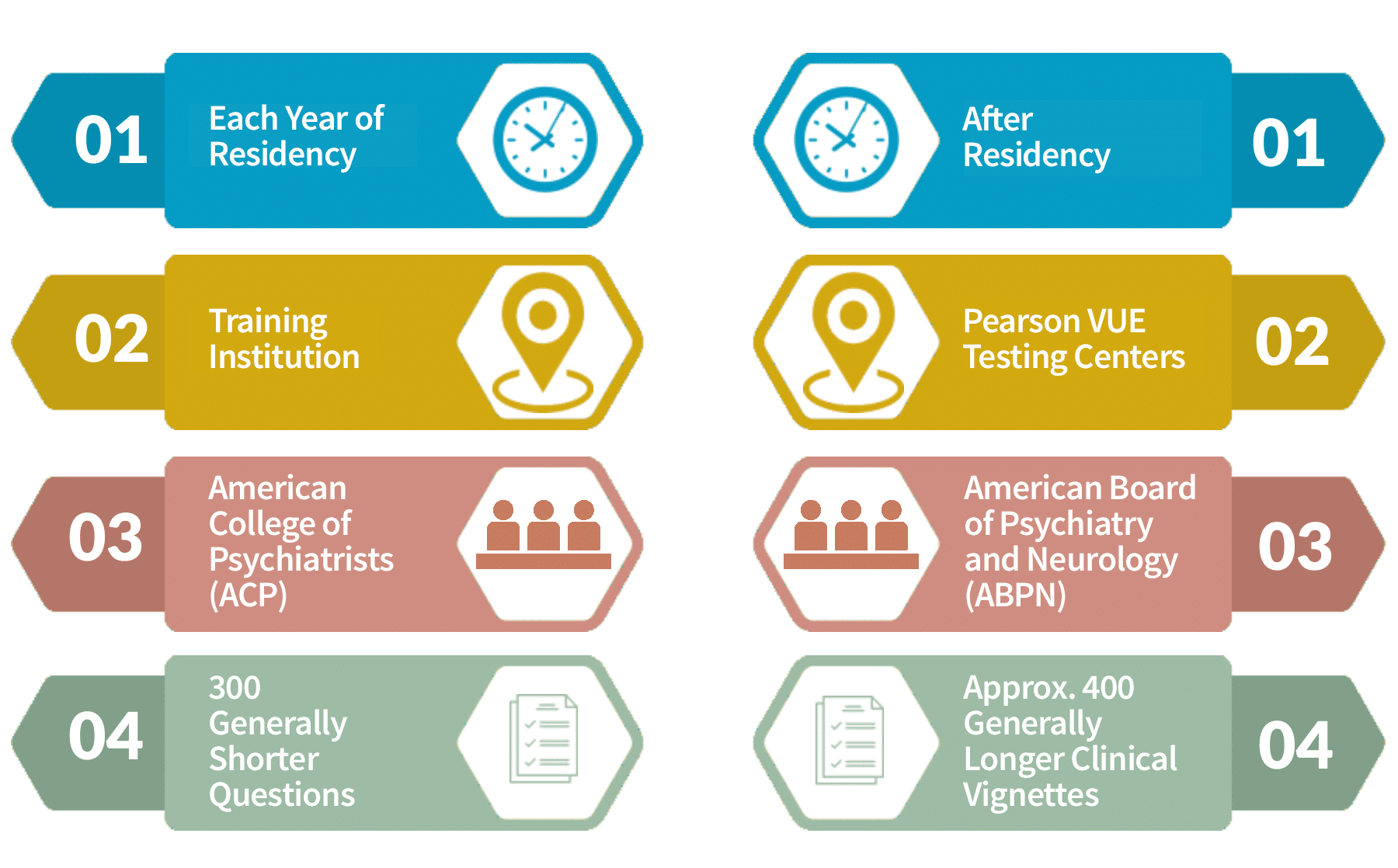
PRITE vs Board Certification Exam

Types of Psychotherapy Covered on the PRITE

The PRITE covers a wide range of psychotherapy types under its “Treatment Across the Lifespan” and “Behavioral & Social Sciences” sections. The exam tests not just the names of therapies, but their underlying theory, indications, key techniques, and practical applications in clinical vignettes. 

Major Psychotherapy Modalities

Psychodynamic and Psychoanalytic Therapies: This area is a cornerstone of the exam. Residents must understand core concepts such as transference, countertransference, catharsis, resistance, defense mechanisms, and interpretation of unconscious conflicts. Both traditional, long-term psychoanalysis and more focused, short-term psychodynamic therapy (STPP) are covered.

Cognitive Behavioral Therapy (CBT) and Behavioral Therapies The PRITE assesses knowledge of CBT principles, including identifying and challenging maladaptive thoughts, cognitive restructuring, and behavioral experiments. Specific behavioral techniques like exposure therapy, flooding, systematic desensitization, and response prevention for conditions like phobias and OCD are also relevant.

Interpersonal Psychotherapy (IPT): This modality, which focuses on improving relationships and social interactions, is frequently covered. Questions may test the understanding of how IPT addresses specific interpersonal problem areas (e.g., grief, role disputes, role transitions, interpersonal deficits).

Supportive Psychotherapy: This is a fundamental skill for all psychiatrists. The exam assesses techniques for building therapeutic alliance, providing support, psychoeducation, and managing difficult patient behaviors or nonadherence. 

Other Relevant Therapies

Dialectical Behavior Therapy (DBT): Residents should know the primary indications for DBT (e.g., Borderline Personality Disorder, self-harm, suicidal ideation) and its core components (e.g., mindfulness, emotion regulation, distress tolerance).

Group and Family Therapies: Understanding the dynamics of group therapy (e.g., transactional dynamics) and dyadic treatments (e.g., couples therapy, parent-child interactions) is included in the content outline.

Interpersonal Psychotherapy (IPT): This modality, which focuses on improving relationships and social interactions, is frequently covered. Questions may test the understanding of how IPT addresses specific interpersonal problem areas (e.g., grief, role disputes, role transitions, interpersonal deficits).

Humanistic and Existential Approaches: Knowledge of general principles of patient-centered care and the focus on personal growth is relevant to the broader field of psychiatry. 


Types of Psychotherapy Covered on the PRITE

Psychodynamic and Psychoanalytic Therapies: This area is a cornerstone of the exam. Residents must understand core concepts such as transference, countertransference, catharsis, resistance, defense mechanisms, and interpretation of unconscious conflicts. Both traditional, long-term psychoanalysis and more focused, short-term psychodynamic therapy (STPP) are covered.

Cognitive Behavioral Therapy (CBT) and Behavioral Therapies: The PRITE assesses knowledge of CBT principles, including identifying and challenging maladaptive thoughts, cognitive restructuring, and behavioral experiments. Specific behavioral techniques like exposure therapy, flooding, systematic desensitization, and response prevention for conditions like phobias and OCD are also relevant.

Interpersonal Psychotherapy (IPT): This modality, which focuses on improving relationships and social interactions, is frequently covered. Questions may test the understanding of how IPT addresses specific interpersonal problem areas (e.g., grief, role disputes, role transitions, interpersonal deficits).

Supportive Psychotherapy: This is a fundamental skill for all psychiatrists. The exam assesses techniques for building therapeutic alliance, providing support, psychoeducation, and managing difficult patient behaviors or nonadherence. 


Other Relevant Therapies

Dialectical Behavior Therapy (DBT): Residents should know the primary indications for DBT (e.g., Borderline Personality Disorder, self-harm, suicidal ideation) and its core components (e.g., mindfulness, emotion regulation, distress tolerance).

Group and Family Therapies: Understanding the dynamics of group therapy (e.g., transactional dynamics) and dyadic treatments (e.g., couples therapy, parent-child interactions) is included in the content outline.

Interpersonal Psychotherapy (IPT): This modality, which focuses on improving relationships and social interactions, is frequently covered. Questions may test the understanding of how IPT addresses specific interpersonal problem areas (e.g., grief, role disputes, role transitions, interpersonal deficits).

Humanistic and Existential Approaches: Knowledge of general principles of patient-centered care and the focus on personal growth is relevant to the broader field of psychiatry. 


Frequently Asked Questions

What is the PRITE exam?

The Psychiatry Resident-In-Training Examination (PRITE®) is an annual exam created by the American College of Psychiatrists (ACP) to help residents and program directors assess clinical knowledge and track progress throughout training.

Learn more about PRITE on the ACP website.

Are Beat The Boards’ lectures and QBank appropriate for PRITE preparation?

Yes. While our courses are not designed specifically for PRITE, many residents and program directors use our psychiatry lectures and question banks to strengthen the same core knowledge domains tested on PRITE—such as psychopharmacology, neuroscience, psychopathology, and clinical psychiatry.

Our content aligns with the foundational knowledge PRITE evaluates, making it a helpful supplement alongside your residency curriculum.

How closely does your content match the PRITE blueprint?

Our lectures and QBank cover the major topics that consistently appear on PRITE. These include:

  • Neuroscience and neuroanatomy
  • Psychopathology and diagnosis
  • Psychopharmacology
  • Clinical cases across adult, child, and geriatric psychiatry
  • Ethics, forensics, and systems of care

While we do not claim an exact one-to-one match with the ACP blueprint, our material reinforces the same clinical reasoning and knowledge areas PRITE measures.

Do you offer practice questions similar to PRITE?

Our question style emphasizes clinical reasoning, differential diagnosis, and evidence-based treatment—skills PRITE also evaluates.

Many residents report that our QBank helps them:

  • Refresh high-yield psychiatry knowledge
  • Practice applying concepts to clinical scenarios
  • Build test-taking confidence ahead of PRITE
Will this help me perform better on PRITE?

Residents tell us that using our lectures and QBank improves their overall psychiatry knowledge and boosts confidence heading into PRITE.

Because PRITE mirrors real-world clinical reasoning, the more familiar you are with core psychiatric concepts, the better you tend to perform.

Do you offer practice questions similar to PRITE?

Our question style emphasizes clinical reasoning, differential diagnosis, and evidence-based treatment—skills PRITE also evaluates.

Many residents report that our QBank helps them:

  • Refresh high-yield psychiatry knowledge
  • Practice applying concepts to clinical scenarios
  • Build test-taking confidence ahead of PRITE
How does the PRITE compare to the Psychiatry Shelf Examination?

The Psychiatry Shelf Exam is for medical students to test their knowledge after a clinical rotation, while the Psychiatry Resident-In-Training Examination is an annual assessment for psychiatry residents to track their progress throughout training.

How should I use Beat The Boards! materials in addition to residency teachings?

We recommend a simple structure:

  1. Watch the lecture for a topic (e.g., mood disorders).
  2. Complete the related QBank questions.
  3. Review explanations to reinforce the “why” behind each answer.
  4. Revisit weak areas or rewatch key lecture segments.

This reinforces the same knowledge PRITE assesses and complements your program’s didactics.

Do program directors use Beat The Boards! courses for PRITE prep?

Many programs incorporate our lectures or QBank questions into their didactic curriculum because:

  • The content is consistently high-yield
  • Explanations help residents deepen understanding
  • Topics map naturally onto PRITE’s core areas

This reinforces the same knowledge PRITE assesses and complements your program’s didactics.

Where can I learn more about the PRITE exam itself?

You can find official exam details—format, administration, and scoring—on the American College of Psychiatrists’ website.

Visit the ACP PRITE page.

Choose Your Beat The Boards! ABPN® Review Course to Learn More

Addiction Medicine Board Review

Addiction Psychiatry Board Review

Child & Adolescent Psychiatry Board Review

Consultation-Liaison Psychiatry Board Review

Geriatric Psychiatry Board Review

Psychiatry Certification Board Review

Psychiatry Continuing Certification Board Review

Have Questions? Let Us Know!

Required Fields*


    By submitting this form, I consent to receive communications regarding my inquiry via email, call, or text. I may opt out of receiving text communication by replying STOP. View Terms & Conditions.

    • Home
    • Login
    • About Us
    • Contact Us
    • Work With Us
    • FAQs
    • Triple Trust Guarantee

    Government Sales – SAM.gov
    Unique Entity ID: LQWHFPP2KLB8

    American Physician Institute for Advanced Professional Studies, LLC BBB Business Review
    • American Physician Institute Facebook link American Physician
    • American Physician Institute Surgery Facebook link Surgery
    • American Physician Institute Anesthesiology Facebook link Anesthesiology
    • American Physician Institute Psychiatry Facebook link Psychiatry
    • www.AmericanPhysician.com
    • www.BeatTheBoards.com
    • www.ThePassMachine.com
    • www.MasterPsych.com

    This site is protected by reCAPTCHA and the Google Privacy Policy and Terms of Service apply.
    • American Board of Anesthesiology®
    • American Board of Emergency Medicine®
    • American Board of Family Medicine®
    • American Board of Internal Medicine®
    • American Board of Pain Medicine®
    • American Board of Pediatrics®
    • American Board of Preventive Medicine®
    • American Board of Psychiatry and Neurology®
    • American Board of Surgery®
    • PeerPoint – CME Accreditation Services
    • Board
      Courses
    • CME
      Courses
    • Personal Finance
      & Career Courses
    • FREE Board
      Resources & Info
    • Residency &
      Fellowship Program
    • Discounts &
      Group Sales
    • Exam
      Blog

    © 2026· American Physician Institute, LLC

    Privacy Policy | Terms of Service
    We’ll get in touch soon!
    Let's Chat
    Let's Chat

    The More You Spend
    The Better the Discount!

    Beat The Boards! biggest savings event of the year is here! From now through the end of the year, save up to an additional 30% off your entire cart when you purchase from any American Physician Institute brand.

    What are the additional End-Of-Year discount amounts?

    • Spend up to $996 → Get an additional 10% off your entire cart
    • Spend $997–$1,996 → Get an additional 20% off your entire cart
    • Spend $1,997 or more → Get an additional 30% off your entire cart

    What makes the End-Of-Year Sale so good?

    1. The majority of our products are already on sale. The End-Of-Year Sale is a sale on top of a sale!
    2. All our products are eligible for the additional End-Of-Year discount, and the degree of the discount increases with a higher total amount spent.

    What do you need to do now?

    • Just keep shopping!
    • The cumulative discount amounts are automatically tracked and presented so you know your total purchase amount and how close you are to the next discount tier.

    If you have any questions, please let us know!

    Close
    Manage Cookie Consent
    To provide the best experiences, we use technologies like cookies to store and/or access device information. Consenting to these technologies will allow us to process data such as browsing behavior or unique IDs on this site. Not consenting or withdrawing consent, may adversely affect certain features and functions.
    Functional Always active
    The technical storage or access is strictly necessary for the legitimate purpose of enabling the use of a specific service explicitly requested by the subscriber or user, or for the sole purpose of carrying out the transmission of a communication over an electronic communications network.
    Preferences
    The technical storage or access is necessary for the legitimate purpose of storing preferences that are not requested by the subscriber or user.
    Statistics
    The technical storage or access that is used exclusively for statistical purposes. The technical storage or access that is used exclusively for anonymous statistical purposes. Without a subpoena, voluntary compliance on the part of your Internet Service Provider, or additional records from a third party, information stored or retrieved for this purpose alone cannot usually be used to identify you.
    Marketing
    The technical storage or access is required to create user profiles to send advertising, or to track the user on a website or across several websites for similar marketing purposes.
    • Manage options
    • Manage services
    • Manage {vendor_count} vendors
    • Read more about these purposes
    View preferences
    • {title}
    • {title}
    • {title}